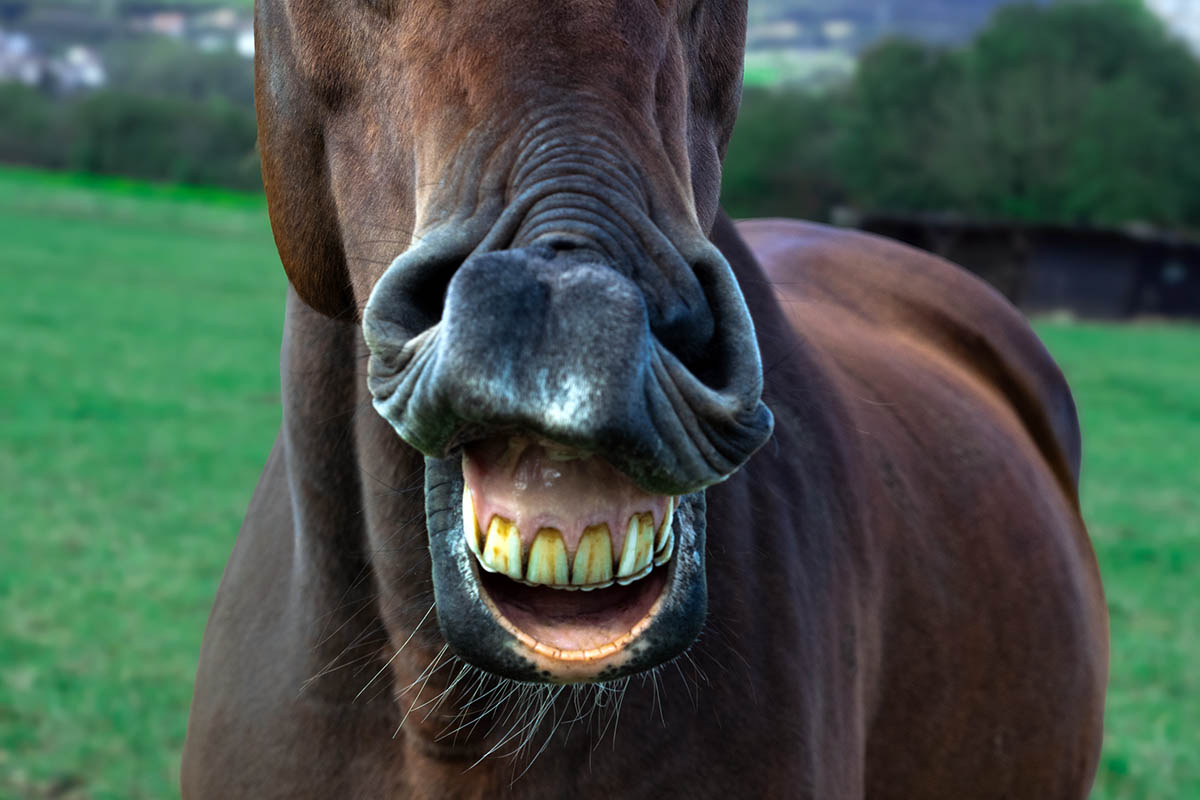
If you don’t know a horse’s date of birth, taking a close look at his teeth can provide some clues. This method of aging a horse isn’t 100 percent accurate, but it will give you an approximate age range. The younger the horse, the more accurate the approximation will be. Here are four characteristics to look for when determining a horse’s age by his teeth.
1. Permanent Teeth
Horses have two sets of teeth: temporary teeth called “baby” or “milk” teeth and permanent teeth. In a 1-year-old horse, all the temporary teeth have erupted. By 3 years old, most horses will have permanent center teeth, both upper and lower. Permanent teeth are larger and darker than baby teeth. By age 5, all the baby teeth are replaced by permanent teeth. At this point, the horse has a “full mouth.”
2. Cups
On the grinding surface of the permanent incisors, you’ll see an indented area with a darkish middle in the center of each tooth. This is called the cup, and horses can be aged by their disappearance. At 6 years old, the cups disappear from the bottom central incisors. At 7, they disappear from the intermediates, and by 8, they’ve disappeared from the corners. The top incisors lose their cups from the centrals, intermediates, and corners at 9, 10, and 11 years of age, respectively. By 12, the cups are gone, and a horse of this age is sometimes referred to as a “smooth-mouthed horse.”
3. Galvayne’s Groove
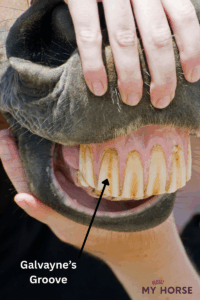
The Galvayne’s groove is a dark vertical groove that occurs on the outer surface of the upper corner incisor teeth in mature horses and extends down the length of the tooth. The groove first appears at the gum line in the center of the tooth when the horse is about 10 years old. At 15 years, the groove extends halfway down the tooth. By 20, the groove extends the entire length of the tooth. After 20, the groove begins to disappear from the top of the tooth. By 25, you’ll only see the groove on the bottom half of the tooth, and by 30, the groove is entirely gone.
4. Angle of Incidence
As a horse ages, the angle of meeting between the upper and lower incisors becomes more and more acute as the incisors slant forward and outward. In young horses, the angle is between 160 and 180 degrees. In a very aged horse, the angle might be 90 degrees.
Related Reading:
This article originally ran on Equisearch.com.
Are you enjoying this content? Sign up for My New Horse’s FREE newsletter to get the latest horse owner info and fun facts delivered straight to your inbox!