It doesn’t matter whether your new horse is a stout Haflinger, a sleek off-track Thoroughbred, or a BLM mustang—all horses have strong biological drives to meet certain needs. Those needs include living in social groups, grazing almost continuously, and engaging in a wide range of species-typical behaviors while moving freely.
Natural selection played a role in what your horse’s ancient ancestors looked like. For example, horses that evolved in hot, arid conditions (e.g., Arabians) look quite different from those that lived in cold, wet climates (e.g., Icelandic Horses). Around 5,000 years ago, we humans began to selectively breed horses to further change their size, shape, and abilities. However, we have not been able to breed out their instincts and strong drives. These are so innate that, unlike our domestic dogs, most horses would likely survive if “set free” in an area with adequate resources.
When horses are kept or managed in ways that thwart their ability to fulfill such drives, they experience physical and psychological stress. This profoundly affects their well-being and causes them to behave in undesirable ways as a result. Historically, we often put the blame on the horse for this behavior, labeling them as bad. We even blame the horse for behaviors such as cribbing or stable vices. These have been more accurately referred to as diseases of domestication, because horses living under natural conditions don’t behave this way.
Related: A Journey Through Time: How Horses Evolved
Meeting Your Horse’s Basic Needs
Our modern world makes it challenging to meet the basic needs of the horse. Large parcels of grazing land are disappearing, and owners have limited time to spend with their horses, which requires them to be nearby and accessible. However, we can still improve most living situations to better meet their needs. Environmental enrichment is just that: Taking deliberate steps to alter the environment, providing them with more opportunity to perform the wide range of behaviors in which they would engage if living under natural conditions.
It is critical to first meet the horse’s basic needs by allowing them ad lib access to suitable forage, ensuring they are always near and with other horses, and can move freely in regular turnout. From there, we can add things to their environment that further enhance their ability to behave more normally. This means interacting socially with others, finding and ingesting food, solving problems and overcoming adversity, making choices about how to behave, and moving at will.
Examples of environmental enrichment include:
- Adding small piles of different types of hay or other safe foods to an enclosure to increase time spent exploring to find food and ingesting that food.
- Creating an area without grass in a pasture to give horses the opportunity to roll and dust bathe, self-groom, and perform insect control.
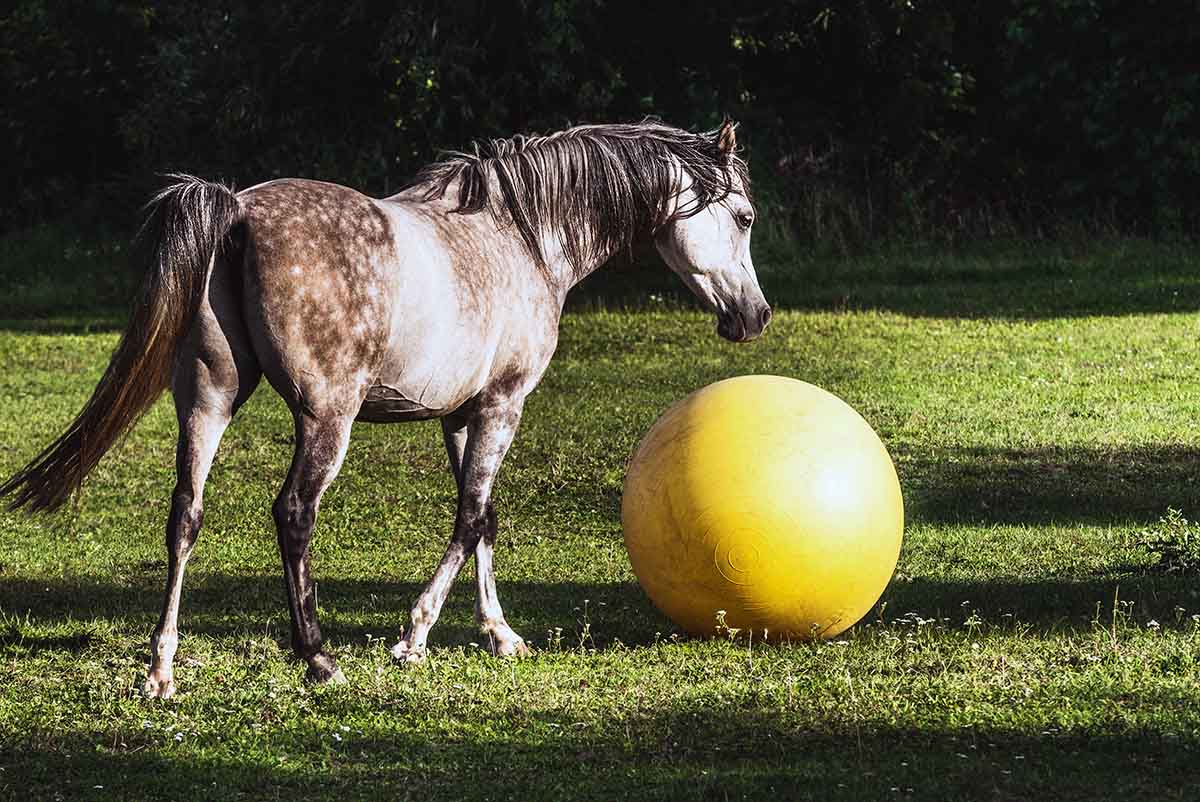
- Adding safe, novel (new) objects to an environment, such as a length of log that’s safe to nibble on, a yoga ball or kid’s wading pool, or a bucket of water with a few horse-appropriate, non-caffeinated herbal tea bags (like peppermint) in it to encourage curiosity and exploration.
Environmental enrichment for horses as a concept has taken off over the past few years. A quick online search will provide you with countless creative and budget-friendly ideas.
Take-Home Message
Good welfare isn’t just the absence of pain, stress, or negative emotional states. It is entirely possible for a horse to not be in pain, have no exposure to strong stressors, and not experience fear, but still have poor welfare. When horses have limited ability to engage in normal behaviors, experience novelty, and learn from their environment, their well-being suffers. Environmental enrichment is one way we can enhance our horses’ lives and greatly improve their well-being.
Related Reading
Lauren Fraser, MSc, FFCP, has helped people understand horse behavior problems since 2006. With a background working as a horse trainer, an MSc in clinical animal behavior, and more than a decade working as an equine behavior consultant, Lauren’s approach gets to the heart of why horses behave the way they do and addresses issues using low-stress methods. Lauren also guest lectures at universities, presents at conferences, and creates educational programs for horse owners and equine professionals.
Are you enjoying this content? Sign up for My New Horse’s FREE newsletter to get the latest horse owner info and fun facts delivered straight to your inbox!