
Have you ever wondered whether horses can see as well in the dark as they do during the day? Or why at dusk, your horse sometimes hesitates before walking into a stall or trailer? Let’s demystify equine night vision and give you practical tips for handling your horse safely when the sun goes down.
What Makes a Horse’s Eyes Special?
Horses’ eyes are fascinatingly adapted to life as prey animals on open terrain.
More Rods = Better Low-Light Vision. Horses have a higher ratio of rod photoreceptors (the cells designed for dim-light vision) than humans. According to the University of California, Davis, a horse’s rod-to-cone (bright-light/color cells) ratio is around 20:1, compared to about 9:1 in humans. This means horses are uniquely equipped to detect light and motion in low-light conditions.
Tapetum Lucidum: The Night Vision Booster. Behind the retina of a horse’s eye lies a reflective layer called the tapetum lucidum. This layer essentially “recycles” incoming light by reflecting it back through the retina so those rods get a second chance to absorb it. It’s why horse eyes seem to glow if you shine a light in them at night.
Wide Field of View. Horses’ eyes are set on the sides of their heads, giving them nearly panoramic vision. While this feature is great for spotting predators, it means their depth perception directly in front isn’t as sharp as a human’s.
Related: A Journey Through Time: How Horses Evolved
So … Can Horses See in the Dark?
Yes, but not perfectly. Horses can see in low-light conditions and at night better than humans because of their eye structure and light-sensitive rods. Under moonlight or starlight, a horse often navigates quite well. However, their night vision does have flaws:
- They can’t see in total darkness. Horses still need some light (moonlight, reflective surfaces, etc.) to make out objects.
- In dim light, they notice silhouettes and movement more easily than details like texture or color.
- They lose color vision in low light and depend mostly on contrast and motion.
In other words, your horse can probably navigate a familiar field under a full moon with no problem but might be lost in a totally unlit arena.
Why Horses Sometimes Hesitate at Night
If your horse seems reluctant to walk into a dark area, it’s not that he’s “scared of the dark.” More likely, it’s because his eyes simply take longer to adjust than ours do.
While humans typically adapt to dim conditions in about 20 minutes, a horse’s eyes can take around 45 minutes to fully adjust when moving from bright to dark areas.
So a horse leaving a sunny field for a dark barn or trailer might freeze—not out of fear, but because the contrast is stark and their vision hasn’t caught up yet. We humans often mistake that moment of uncertainty for spookiness.
Tips for Handling Horses at Night
Whether you’re bringing horses in at dusk, riding early in the morning, or just doing barn chores after sunset, here are some practical tips to keep both you and your horse safe:
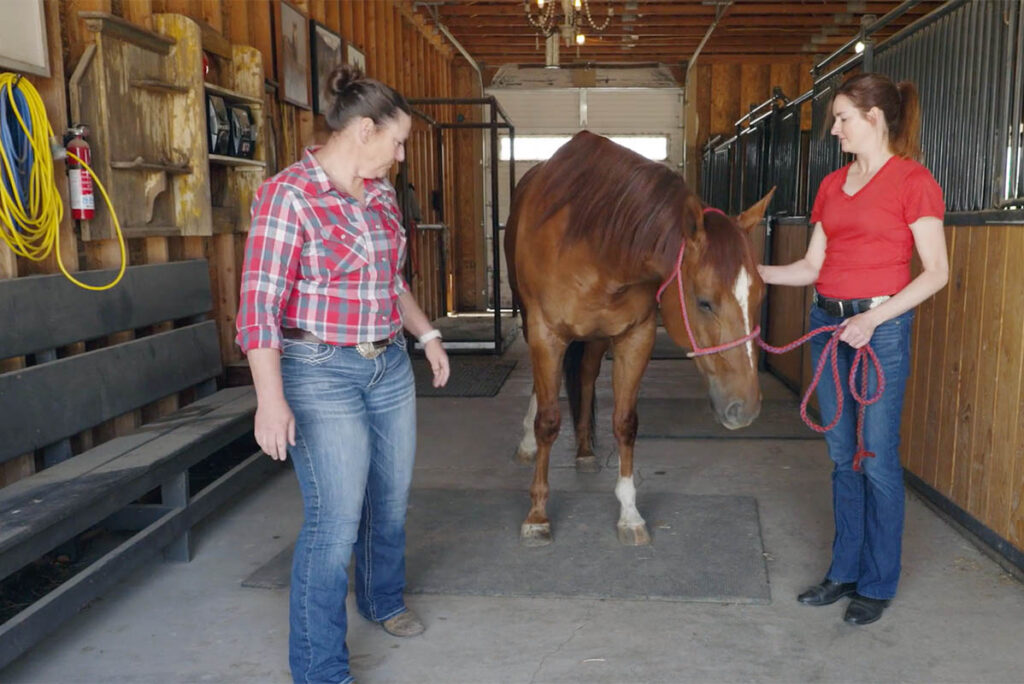
- Let Your Horse’s Eyes Adjust. Pause in shaded or dim areas before asking your horse to enter a much darker space like a barn aisle or trailer.
- Use Gentle, Consistent Lighting. Soft lighting, especially along pathways, can help both you and your horse see without overwhelming their sensitive eyes.
- Approach Calmly and Predictably. Sudden movements or flashes of light can startle a horse whose vision is still adapting. Speak calmly and keep your motions smooth.
- Equip Yourself Too. Carry a flashlight or wear a headlamp, especially if working or moving around in spots where you need to see obstacles clearly.
- Know the Terrain. Horses do best in familiar territory. If riding at dusk or night, stick to trails or arenas you both know well.
Final Thoughts
Horses have evolved eyes that help them graze, move around, and sense motion even as light fades. While their night vision is better than ours, it doesn’t react as quickly to changing light. Understanding how horses see in low light lets you appreciate their strengths and helps you make safer, more confident choices when the sun sets.
Related Reading:
Are you enjoying this content? Sign up for My New Horse’s FREE newsletter to get the latest horse owner info and fun facts delivered straight to your inbox!