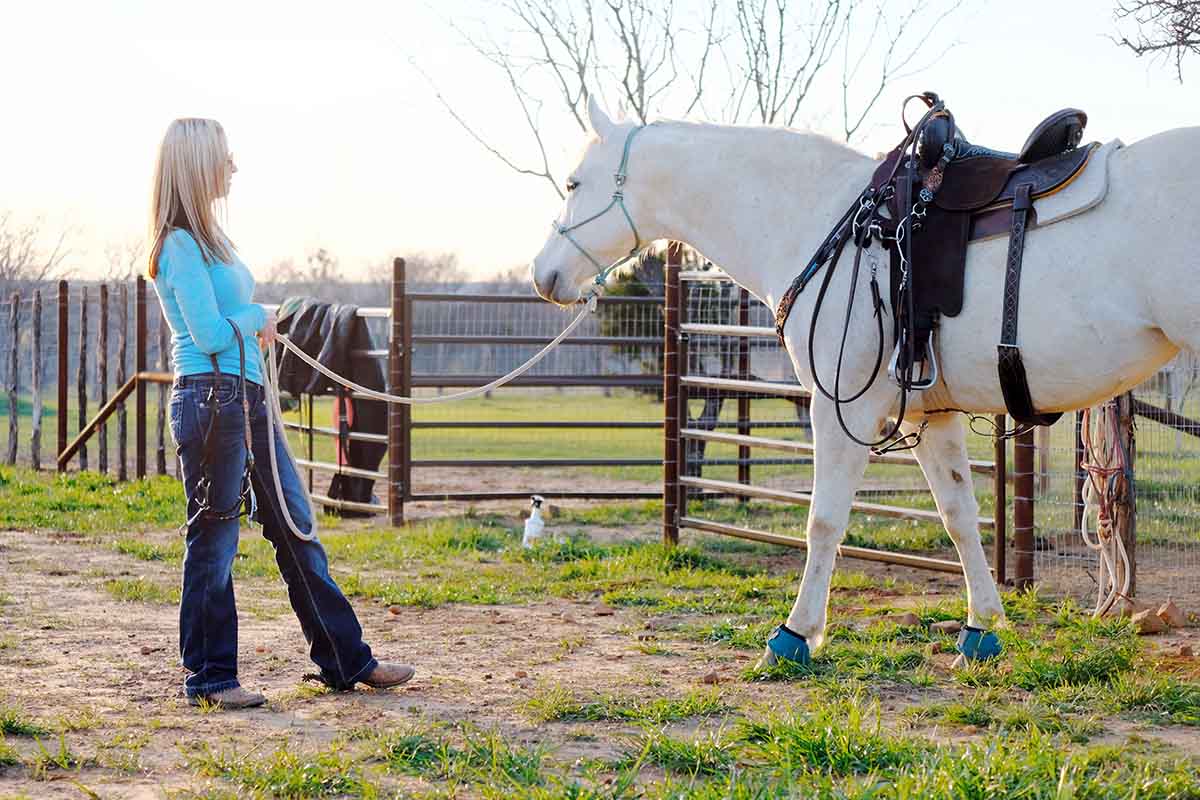
If you’re new to horses, you have a lot to learn. Every barn outing, grooming session, and ride can be exciting. But knowing how to handle horses properly while you’re at it keeps both you and your horse safe. Luckily, you can avoid some of the most common beginner horse handling mistakes with just a little know-how. Here are the top four mistakes I see when beginners handle horses.
1. Misunderstanding horses as a species.
Over tens of millions of years, the horse has evolved to fill a certain niche in which they can thrive. This has resulted in three hardwired biological drives:
- To always be in the company and safety of other horses.
- To graze near continuously.
- To move freely over long distances.
These innate needs remain strong, even in selectively bred domestic horses. If we fail to allow horses to fulfil these drives, they experience chronic stress, making them harder to handle and manage.
By ensuring your horse can spend each day in the company of other horses, eating free-choice forage (using slow-feeder hay nets if needed), moving freely, and engaging in a wide range of normal behaviors, he’ll be safer to handle, easier to train, and feel more fulfilled.
2. Not being aware of how horses perceive the world.
As a prey animal, the horse’s senses have evolved differently from our own. This can cause problems when we expect them to respond to situations the same way that we might. For example, in rapid changes of light, the horse’s eye takes much longer to fully adapt (up to 45 minutes), which is twice as long as our eyes need. This means leading your horse from bright sunshine into a shaded barn might cause him to balk or become spooky because he cannot see properly. Aspects of the horse’s other senses, such as smell, hearing, and even touch, are different from ours too. This can account for behavioral responses that people find frustrating if they don’t understand them.
Related Reading: Can Horses See in the Dark? A Guide to Equine Night Vision
3. Not knowing the basics of how horses learn.
“Just because you don’t intend to teach a horse something doesn’t mean you won’t, and just because you are not aware of having taught a horse something doesn’t mean you didn’t.” —J. Hagerbaumer
One of the basic ways all animals learn is through learning theory. In short, animals can form involuntary, emotional associations about things or experiences. They can learn that their voluntary behavior results in consequences, both wanted and unwanted. For example, as a result of rough handling, a young horse might learn that being led toward a trailer is painful and scary, and that if he fearfully pulls the lead rope out of the trainer’s hand, he can escape and feel less afraid. Another horse, handled with more understanding, might learn that being led toward the trailer triggers no negative emotions, and that their voluntary behavior of stepping into the trailer results in withers scratches or a tasty treat.
Additionally, horses are very intelligent animals. But how and what they have evolved to learn gives them different mental abilities from us. For example, they lack the cognitive structures needed to plan for the future, plot and scheme, or fake being ill or lame. Yet, it’s common for people to mistakenly attribute these abilities to horses.
Related Reading: Understanding the Basics of How Horses Learn
4. Not paying close attention to their body language.
Horses communicate with one another primarily through body language. This makes sense, considering that silent communication is a powerful advantage for a prey animal. How they behave can signal to others if it’s safe to graze or sleep or if a predator or potential threat is nearby.
The study of equine body language is becoming well-established. Using evidence-based research, we can better identify how horses might feel from moment to moment. We can even use this information to predict what they might do next. For example, when we know what to look for, we can see signs of increasing fear, anxiety, or stress in a horse, and we can take action to reduce those feelings (or even a big explosion), making the horse feel better and be safer to handle.
Summary
When we understand horses as a species, appreciate how they perceive the world, know how they learn, and pay close attention to their body language, it pays dividends for us and them. The horse benefits from improved welfare and reduced stress, and we become safer around horses. As a pleasant side effect, this knowledge enhances the horse-human bond.
Related Reading:
Lauren Fraser, MSc, FFCP, has helped people understand horse behavior problems since 2006. With a background working as a horse trainer, an MSc in clinical animal behavior, and more than a decade working as an equine behavior consultant, Lauren’s approach gets to the heart of why horses behave the way they do and addresses issues using low-stress methods. Lauren also guest lectures at universities, presents at conferences, and creates educational programs for horse owners and equine professionals.
Are you enjoying this content? Sign up for My New Horse’s FREE newsletter to get the latest horse owner info and fun facts delivered straight to your inbox!