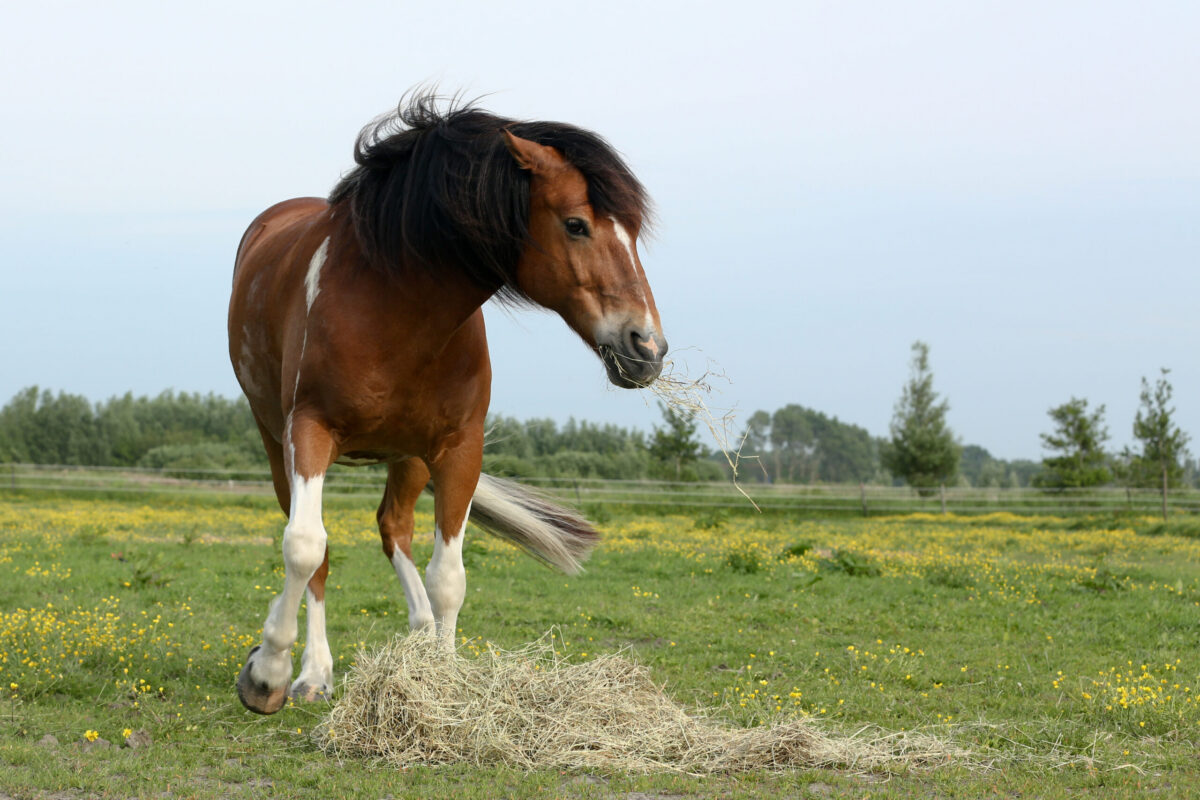
Feeding time can become tense if your horse pins his ears, crowds the gate, or swings his hindquarters as soon as food is involved. Food aggression can be particularly unsettling (and even unsafe) if you’re still building confidence with your new horse. Here’s some important advice if your horse behaves aggressively around food.
What Is Aggression and Why Does it Matter?
Most people can point out things like ear pinning, swinging the rump, or kicking, striking, or biting as aggressive equine behaviors. But accurately defining aggression and understanding its root causes can be trickier. Often, people claim that horses become aggressive around food because of dominance. However, this isn’t always the case, leading to misguided attempts to address the issue. Horses behave aggressively around food for many reasons, each requiring a different solution.
Aggressive behaviors are those intended to forcefully control the behavior of another. When we think of aggression in people, we often pair it with the human emotion of anger. But the one behaving aggressively might be doing so because they feel other strong emotions, such as fear or sadness. Or they might be experiencing physical pain or feel threatened by the potential loss of something they value.
Horses display aggression for similar reasons. If frightened, they might resort to fighting the threat to escape the situation. The loss of a close herdmate can dramatically alter a horse’s mood, triggering aggression toward others. Pain is a frequent cause of aggressive behavior in horses because controlling the behavior of others (such as a person trying to saddle the horse) can reduce or end painful sensations. Or, when horses perceive a valued resource like food to be in short supply, they might behave aggressively to control it. In all instances, horses might even “redirect” their aggression toward an innocent bystander if they can’t access their true target in that moment.
It’s critical to understand a few things about aggression in horses:
- It’s a normal behavioral response of all animals, particularly to perceived threats.
- It usually only occurs when other means to gain control of the situation, such as fleeing, can’t work.
- It’s an “expensive” behavior, requiring the animal to exert strength and energy while risking injury or death and, therefore, isn’t chosen lightly.
When we see aggression in horses, particularly around food, it’s a sign that calls for further investigation so we can best help the horse.
How Do Horses Typically Behave Around Food?
If you think about how horses naturally eat, it’s easy to see that displays of aggression around food aren’t species-typical behaviors. Horses have evolved to live in groups that move 20-100 miles a day, grazing on freely available forage as they go. They eat nearly continuously, in some instances up to 18-20 hours a day.
Social predators, such as wolves, often hunt cooperatively for food, then engage in a nuanced social ranking dance of aggressive threat displays to decide who eats what and when. But when food is scarce for horses living in natural conditions, they tend to spread further apart, not fight over each small patch of grass. Even when faced with finite resources, such as salt or mineral licks, horses usually just take turns or occasionally jostle one another to gain access, instead of fighting.
Why Horses Show Food Aggression Toward Other Horses
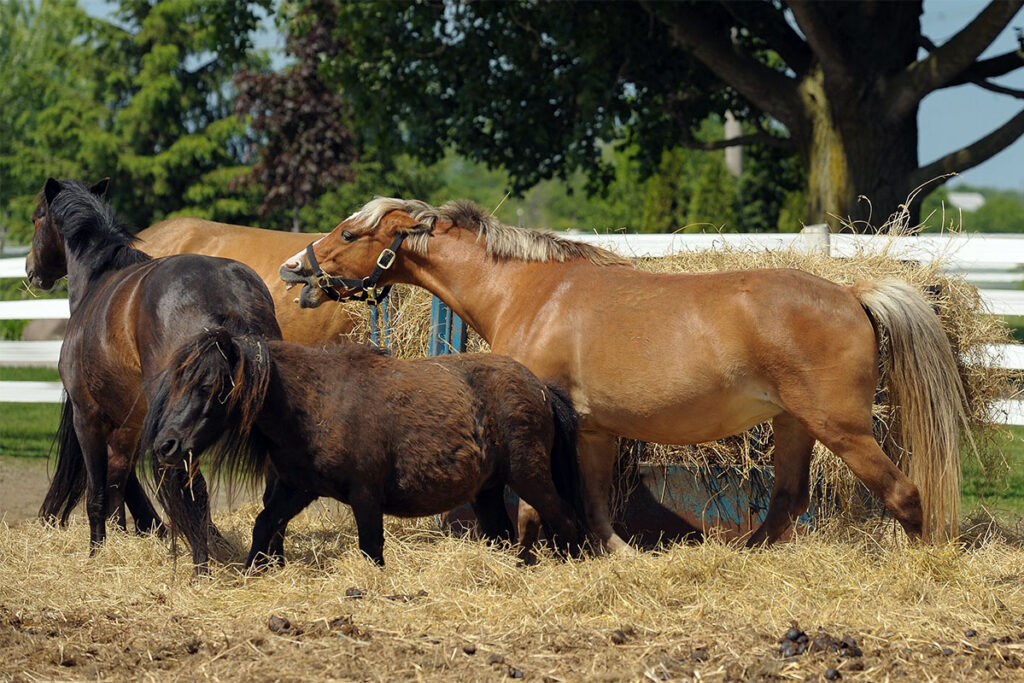
Aggression around food often isn’t just about the food. Our daily management practices can create conditions that result in higher baseline stress levels, affecting horses’ behavior and triggering aggression. For example, both socially isolating horses and putting them into poorly matched group living situations can cause chronic stress. The same goes for keeping horses in conditions that don’t allow them to perform a wide range of species-typical behaviors. Examples include moving freely in large, enriched environments, grazing, rolling, and interacting socially with others. Higher baseline stress reduces a horse’s ability to cope, causing them to be more reactive.
How we feed horses can further set them up to display aggression toward others. In group settings, horses might view one round bale or several piles of hay in a dry lot as a resource in short supply. But grazing in a group on a large, sparsely grassed pasture doesn’t trigger the same aggression toward others.
Periods of starvation can also create conditions that profoundly affect a horse’s behavior around food, even after recovery. Besides building strong, unpleasant memories of life-threatening scarcity, starvation can cause painful gastric ulcers. Perhaps ironically, certain foods as well as the act of food entering the stomach and starting the digestion process can worsen the pain.
Other conditions can also cause gastric ulcers. Otherwise physically fit horses exposed to periods of imposed fasting or repeated short-term or chronic stress can quickly develop ulcers. Ulcer pain can cause redirected aggression toward others around food. This is because they cannot attack the source of the pain and make it go away.
Even if treated for gastric ulcers and managed and fed appropriately, horses might still display aggression toward others around food. This is often a result of prior learning, whereby the horse previously learned behaving that way allowed them to gain access to a valued resource, even if it is currently in abundant supply.
Finally, bringing highly valued resources, such as grain meals, into group settings can trigger aggression in horses. Some horses might show offensive aggression in this moment, proactively trying to take control of the situation and the resource. Others will behave more defensively, only showing aggression in response to threats from others.
Why Horses Show Food Aggression Toward People
As noted, horses might behave aggressively toward people around food because of feelings of pain or frustration due to unmet needs. They might also behave this way when they feel threatened as a result of past experiences. For example, if a handler doesn’t understand the causes of food aggression in horses, they might try to correct or punish a horse for aggressive threats when delivering food. This can greatly worsen the aggression.
I have had many cases over the years where horses were punished for pinning their ears when a person approached with food. This caused them to escalate and attack people for punishing the smaller threat behavior. In these cases, we must address the underlying issue rather than punish the “symptom” of the deeper problem.
Positive-reinforcement-based training with food often gets a bad rap. Some people claim it causes horses to become mouthy or aggressive around food. But it’s critical to understand that positive reinforcement training itself isn’t necessarily at fault. Rather, other factors discussed here can profoundly affect how the horse feels about food use in that context, which can create problems. This is why I recommend getting qualified supervision when adding this useful tool to your training toolbox.
Related: Dealing With a Mouthy Horse: Do’s and Don’ts
How To Resolve Food Aggression
When horses behave aggressively around food, they’re showing an underlying level of stress that we need to address. No horse wants to feel this way. And most owners don’t want their horse to feel or behave this way, either. Educating yourself on the many possible causes of the problem is the first logical, important step.
Next, getting to the root cause of an individual horse’s aggression involves some behavioral sleuthing. This usually begins by gathering helpful data—what clinical animal behaviorists often call the ABCs of the problem:
- The antecedents, things that “set the stage” for the behavior to happen.
- “Who, what, where, when, why, and how” information about the behavior itself.
- Any consequences the horse might receive for performing the behavior.
A critical next step is often managing the environment. You want to avoid repeatedly putting the horse in situations that trigger the behavior. Keep in mind that if your horse continues to display aggression, he is feeling stress. He is also becoming more “practiced” at behaving that way. Both factors make it harder to overcome the problem in the long term.
In Summary
When your horse is aggressive around food, it can feel scary or overwhelming. But take some comfort in knowing that most horses can show great improvement with the right support and management changes. If your horse’s aggression is dangerous to horses or people or if the issue feels too daunting to tackle on your own, consider getting professional support to help your horse feel safer around food.
Related Reading:
Lauren Fraser, MSc, FFCP, has helped people understand horse behavior problems since 2006. With a background working as a horse trainer, an MSc in clinical animal behavior, and more than a decade working as an equine behavior consultant, Lauren’s approach gets to the heart of why horses behave the way they do and addresses issues using low-stress methods. Lauren also guest lectures at universities, presents at conferences, and creates educational programs for horse owners and equine professionals.
Are you enjoying this content? Sign up for My New Horse’s FREE newsletter to get the latest horse owner info and fun facts delivered straight to your inbox!