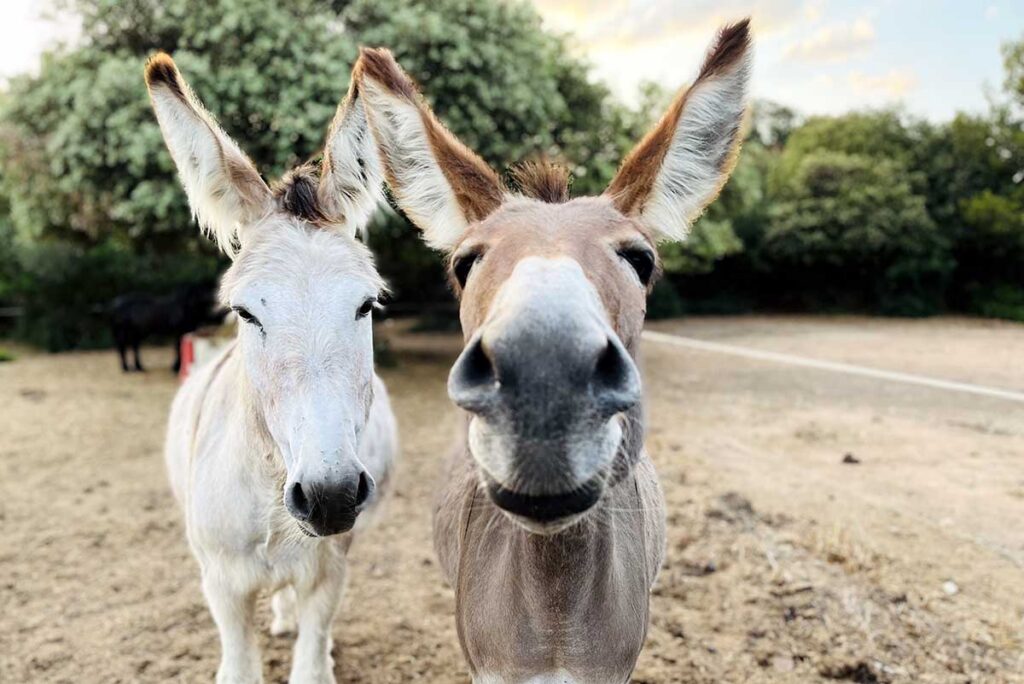
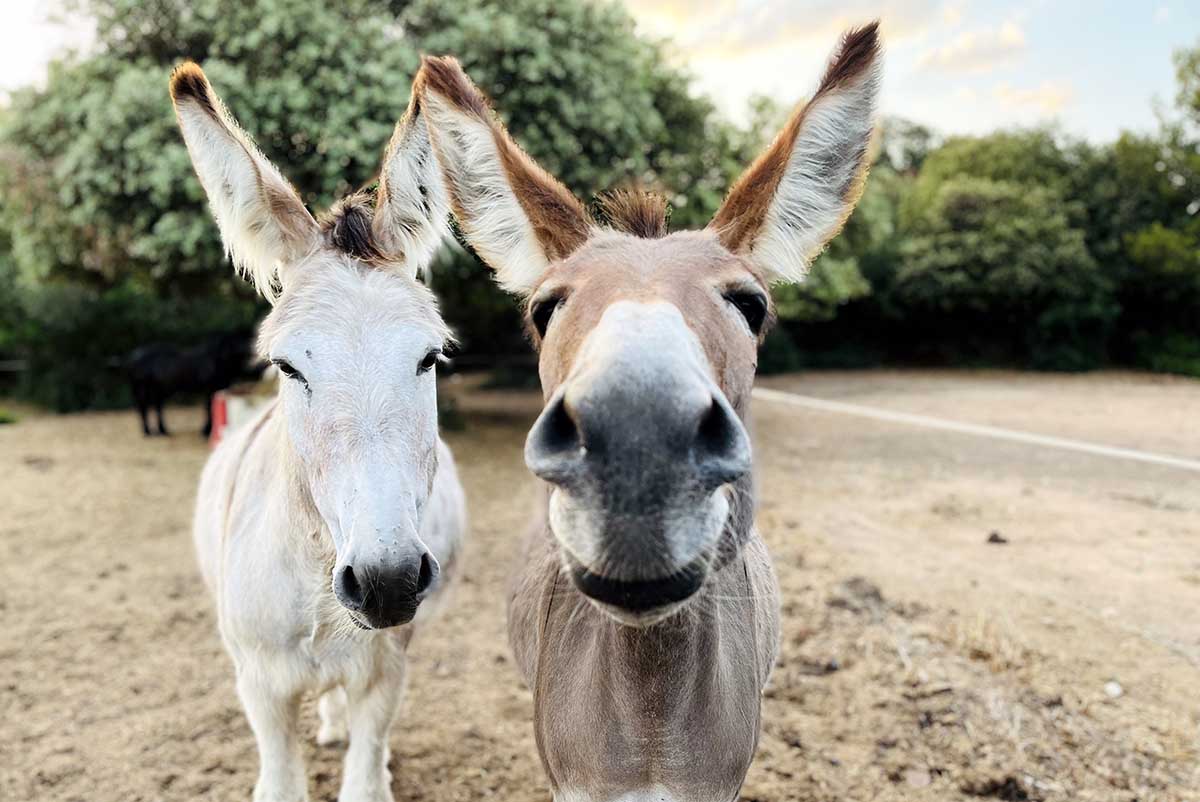
Zebras, horses, and donkeys are species that belong to the genus Equus. Individuals of the same species within a genus can mate and have fertile offspring. Differing species within a genus can also breed with one another, but their resulting offspring will usually be infertile. For example, a horse and a donkey (different species) can produce a hybrid, infertile animal called a mule.
While each Equus species shares similarities with the others, such as a long neck, a mane and tail, and similar gastrointestinal tracts, all evolved in separate ecological niches. This led to not only varying looks but also some behavioral differences.
Donkey Behavior
A basic understanding of horse body language will give you a good baseline level of knowledge when it comes to reading donkey body language. The first thing to note is the donkey’s overall bearing—both their outline as if seen as a silhouette image and the quality of their movement and attention. Pairing this with observations of discrete behaviors (small, subtle changes in the head and neck, tail, ears, eyes, mouth, or nostrils) can give us further clues about the donkey’s arousal, or “activation” level, and emotional state. This information can even help us predict how the donkey might behave in certain situations and allow us to change our approach, if needed, to maintain a mutually enjoyable interaction. Understanding the donkey’s evolutionary path can also help fine-tune our ability to interpret their body language.
Evolution’s Effects
The ancestors of modern-day donkeys evolved in arid areas with minimal plant diversity and growth. As a result, donkeys are more efficient at utilizing smaller volumes of lower-quality foods than horses. This food scarcity also meant animals had to disperse to obtain enough food each day, leading to differences in social structures compared to horses. Wild male donkeys in arid conditions are more territorial than horses, protecting the area’s resources, while the females generally live nomadic lives, passing through territories. By contrast, wild horses live in groups and form stable bands, providing safety in numbers, rather than independently defending a territory.
Social Hierarchies
Interestingly, a donkey’s social organization can vary depending on environmental conditions. For example, in mesic regions (areas with enough moisture to support a wide variety of plant diversity and growth), donkeys can socially organize themselves more like horses, with harem bands.
Differences in social order often mean donkeys respond to frightening threats differently than horses. Donkeys tend to display more freeze or fight responses when faced with potential threats, versus fleeing as a group as horses might. While freezing and fighting are normal first-line responses to threats for donkeys, these behaviors frequently earn them labels like “stubborn.” When interacting with donkeys, be aware that behaviors such as balking or refusing to move can be signs of negative emotional states such as fear. If ignored, the donkey might display aggressive behaviors or “fight” to escape the situation.
Donkey Communication
While they do communicate with one other through body language, as a species donkeys have evolved to do this less often than more gregarious horses. The group-living horse must be able to communicate to others when danger is near, so they can all flee together. This means donkey body language can be more subtle than the horse, making them harder for people to understand.
Be prepared to slow down when working with donkeys, and pay close attention to small, subtle shifts in body language, such as turning the head slightly or leaning away, which can indicate they feel stressed. This trend toward freezing, what some call stoicism, also makes donkeys more at risk when it comes to pain and illness. A donkey that appears depressed or dull is likely much more uncomfortable or ill than a horse behaving the same way. As a result, a donkey’s welfare may become compromised quickly without anyone noticing.
Domestic donkeys can bond very strongly to certain companions, resulting in extreme distress, illness, or even death if the two are separated. But this behavior isn’t seen in wild donkeys, and it is an area that deserves more research. The closest bonding seen in wild donkeys is usually between a female and her offspring, but only until weaning occurs and they go their separate ways.
Mule Behavior
As a horse and donkey hybrid, the mule’s body language is a blend of the two species, making them challenging to work with for inexperienced people. Much like their donkey sires, mules are well-known for having excellent memories and retaining lessons learned—for better or worse. Research has shown mules can even outperform both donkeys and horses on tests for certain learning abilities. Scientists speculate that this could be a result of the hybrid vigor phenomenon, whereby offspring gain enhanced traits from both parents. Like donkeys, mules are also less demonstrative when they are ill or in pain.
In Summary
Donkeys and mules aren’t just horses with longer ears. By considering factors that shaped the donkey’s evolution, we can gain insight into why their behavior and body language differ from horses. This information can help us better appreciate and understand these wonderful animals so we can respond appropriately to their body language during handling.
Related Reading:
- From Body Language to Behavior: How Horses Communicate
- Understanding Behavioral Signs of Pain in Horses
- Understanding Fear Response in Horses and How it Develops
Lauren Fraser, MSc, FFCP, has helped people understand horse behavior problems since 2006. With a background working as a horse trainer, an MSc in clinical animal behavior, and more than a decade working as an equine behavior consultant, Lauren’s approach gets to the heart of why horses behave the way they do and addresses issues using low-stress methods. Lauren also guest lectures at universities, presents at conferences, and creates educational programs for horse owners and equine professionals.
Are you enjoying this content? Sign up for My New Horse’s FREE newsletter to get the latest horse owner info and fun facts delivered straight to your inbox!