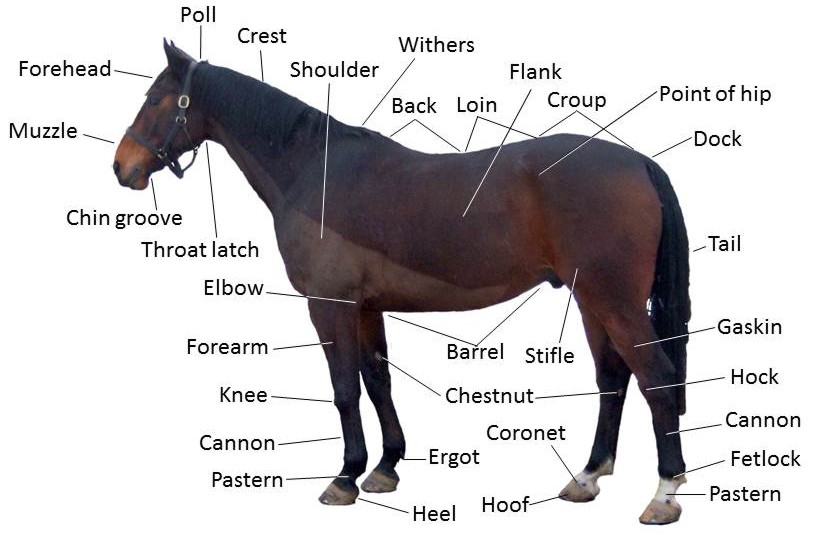
Whether you’re reading a vet report, following a trainer’s advice, or giving your horse a routine once-over, knowing the basic terms of equine anatomy helps you communicate clearly, spot problems early, and better understand how your horse’s body works.
Here’s a glossary of key equine anatomy terms, organized by major body regions for clarity.
Head & Neck
- Poll: The area between a horse’s ears at the top of the head.
- Forehead: The flat area on the front of the face above the eyes.
- Muzzle: The soft, sensitive area at the front of the face that includes the nostrils, lips, and chin.
- Nostrils (Nares): Openings to the nasal passages.
- Jaw (Mandible): The lower part of the skull; forms the lower jaw.
- Throatlatch: The area where the head meets the neck, just behind the jaw.
- Neck: Connects the head to the shoulders; contains vertebrae and major muscles.
Torso (Trunk)
- Withers: The highest point of the back at the base of the neck, where the shoulder blades meet.
- Back: The area from the withers to the loin.
- Loin: The area just behind the saddle and before the croup.
- Croup: The top of the hindquarters, from the loin to the tail.
- Barrel: The main body area, enclosing the rib cage and organs.
- Flank: The area between the last rib and the hind leg.
- Chest: The front part of the body between the forelimbs.
- Girth: The area just behind the front legs where the girth of a saddle goes.
Forelimbs
- Shoulder: Large bone and muscle area connecting the forelimb to the torso.
- Elbow: Joint just below the shoulder.
- Forearm: Between the elbow and the knee; comprising the radius and ulna bones.
- Knee (Carpus): Equivalent to the human wrist.
- Cannon Bone: Large bone between the knee and the fetlock.
- Fetlock: The joint between the cannon bone and the pastern.
- Pastern: The area between the fetlock and the hoof.
- Coronet Band: The top edge of the hoof where it meets the skin.
- Hoof: The hard foot structure, similar to a human fingernail.
Hind Limbs
- Hip: The joint where the hind limb connects to the pelvis.
- Stifle: Equivalent to the human knee; joint between the femur and tibia.
- Gaskin: Muscular area between the stifle and the hock.
- Hock: Joint equivalent to the human ankle; very prominent.
- Cannon Bone, Fetlock, Pastern, Hoof: Same as in the forelimb.
Other Key Terms
- Tail: Extension of the vertebral column; used for communication, balance, and fly-swatting.
- Mane: Long hair along the top of the neck.
- Crest: The top line of the neck, running from just behind the ears down toward the withers, where the mane grows.
- Dock: The bony part of the tail where it joins the body.
- Chestnut: Callous-like growth on the inside of the legs.
- Ergot: Small horny growths on the back of the fetlock.
Related Reading:
Are you enjoying this content? Sign up for My New Horse’s FREE newsletter to get the latest horse owner info and fun facts delivered straight to your inbox!